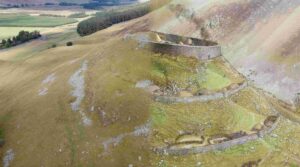
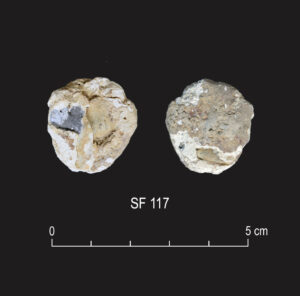
The lithics recovered from Tinnis Castle and the Thirlestane Barrows have been studied now by Lithics Specialist Torben Ballin. Most of the assemblage was merely quartz chips but a flint microlith was found in the earliest layer of Tinnis Castle, underlying the rampart in Trench 1.
There are no local sources of flint – it was probably brought from a coastal area, where it may have been washed out of the till bordering the North Sea shores. The quartz on the other hand could have been collected anywhere in the local area, for example in the form of erratics or pebbles from water-courses.
Microliths are small lithic implements manufactured to form part of composite tools, either as tips or as edges/barbs. These date to the Mesolithic and Early Neolithic periods (ie 8400-3500 BC), so we now have evidence for when the summit of Tinnis was first occupied, long before the fort itself was built.