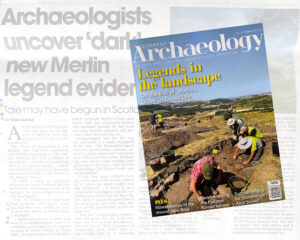
In 2022, a team of volunteers drawn from across Scotland and led by GUARD Archaeology set out to investigate the archaeological roots of the Drumelzier Merlin legend.
The results of their work have just been published and reveals the startling survival of the early medieval cultural heritage of the Britons of southern Scotland.
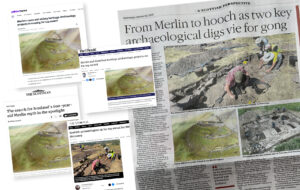
A geophysics survey revealed that there is an archaeological feature resembling a grave near to the reputed location of Merlin’s Grave at Drumelzier. Excavation of Tinnis Fort, which overlooks Merlin’s Grave, found that this prominent hillfort was occupied around the late sixth and early seventh centuries AD when the story was set and that it has the hallmarks of a lordly stronghold of the time. And excavation of the Thirlestane Barrows across the other side of the Tweed discovered that sometime between the late-third and late-sixth centuries AD a square barrow was added to a much earlier group of Bronze Age Round Barrows, within which two individuals of exceptional elite status were buried.
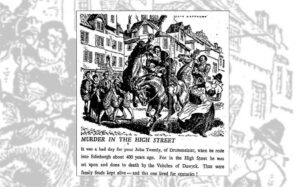
What the findings reveal, is not that the local legend was true but that the Drumelzier legend contains pre-Christian customs, ancient Cumbric names and was associated with local sites where archaeology now shows they could credibly have taken root. This story was not brought here as a wandering medieval tale but more likely originated in Drumelzier itself, perhaps originating as a folk memory, embellished over the centuries before it spread far and wide and changed out of almost all recognition.
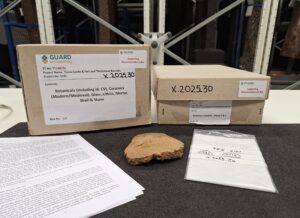
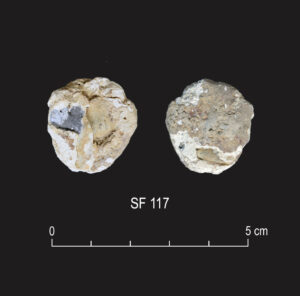
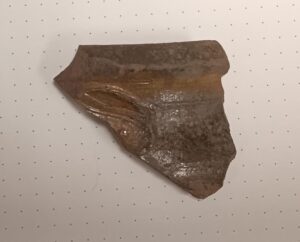
Nor, given the archaeology encountered from the Late Mesolithic/Early Neolithic, Bronze Age, Iron Age and medieval periods, was this the only trace of local stories that the Drumelzier’s Hidden Heritage project discovered. A scatter of Late Mesolithic / Early Neolithic flint blade fragments was recovered from the summit of Tinnis, the barest traces of some of the earliest groups of people to ever climb this prominent hill and from its vantage point gaze across a Tweed Valley that looked very much different from the present. The vitrified ramparts at Tinnis attest to the fall of a Late Iron Age hillfort, the forgotten victims of a forgotten conflict when prominent households vied for power and the foundations for petty kingdoms were being laid. Around 200 years after this the hilltop was re-occupied and the early medieval nucleated fort built. And in the fourteenth century, a castle was built at Tinnis by the fearsome Tweedies of Drumelzier, who held this castle for the Kings of Scotland from about 1366 until about 1525, a bulwark against English raids from the south.

ARO56: Unearthing Ancient Tweeddale: Tinnis Castle, Thirlestane Barrows and Merlin’s Grave is freely available to download from Archaeology Reports Online.
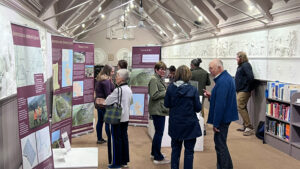
The exhibition Unearthing Ancient Tweeddale at Peebles Museum will run from Saturday 8 June – Saturday 27 July 2024 (closed Wednesdays and Sundays). The exhibition will then be going on tour to Broughton, Drumelzier, Stobo, Traquair House, Eddleston, Moffat, Tweedsmuir, Kirkton Manor and Biggar over the course of August-October 2024.