Early Medieval lead casting waste
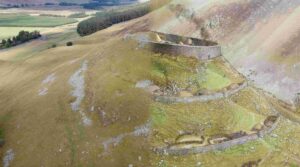
A small assemblage of metalwork was recovered during the excavation of Tinnis Castle and Fort and analysed by the National Museums of Scotland.
The finds found amongst the collapsed remains of the bailey wall included a mix of objects that relate to the medieval use of the castle during the fifteenth and early sixteenth centuries.
This included a fragment of lead window flashing, a small pony-sized horseshoe, iron nails and fragments of two iron knives. Isotope analysis of the lead window flashing by the British Geological Survey’s Geochronology and Tracers Facility revealed that this was made from lead mined in the Pennines.

Medieval lead window flashing
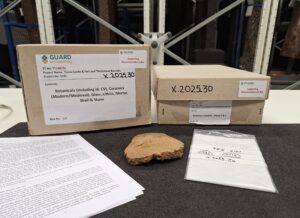
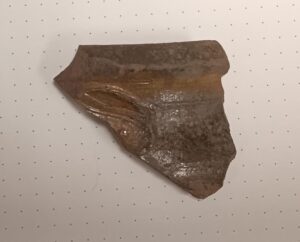
This contrasted with the source of a fragment of lead casting waste recovered from an occupation deposit dated to the ninth to tenth centuries AD, from the underlying fort at Tinnis.
Lead casting waste can be a by-product of melting lead to make lead objects. The isotope analysis showed that this early medieval lead came from the southern uplands of Scotland, possibly quite local.
These results are interesting because they demonstrate fluctuating patterns of trade and access to materials such as lead throughout these periods.