


Merlin and Mungo met at Stobo. Neither knew to expect.
They had been at odds for over ten years, and they were mutually sceptical, each of the other. The debate was not private. It was out-of-doors and lasted three or four days. There would have been quite a buzz of public interest in the debate with a sizeable audience – two old men, haranguing each other in a prolonged disagreement of belief across a broken altar.
It is said that Stobo was originally a sacred site of the old religion but, if so, it seems curious that an ancient pagan altar stone, weighing several tons, was hauled from its site in the woods over a mile away to serve as Mungo’s Christian altar at Stobo. Trying to move it appears to have broken it in half and the Christians seem to have simply settled for taking the one half to Stobo and leaving the other where it still lies today at a place known as Altarstone.
Christianity adopted and adapted traditional holy places and rituals and replaced the outdoor order of nature with the indoor order of men. In the Near Eastern Coptic form which Mungo practised, dogma imposed an autocratic moral authority. It was based on a strict doctrine that brooked no questioning and imbued a sense of guilt, fear, and self-imposed punishment.
Did Merlin and Mungo just agree to disagree? At the end of their meeting, they walked together as far as the Altarstone. Merlin’s supposed conversion is celebrated in a stained-glass window in Stobo Kirk.

But did Mungo really baptise him or just accompany Merlin as a simpler courtesy? On parting he may simply have set him on his way with an attempted blessing but for Merlin the blessing would have been a meaningless gesture, with no requirement for belief on his part.
The Red Book of Hengist quotes Merlin as saying:
I will not receive the communion
From cursed monks
With their pouches on their hips
Let God himself give me communion
Merlin had no need of a Christian priest to serve as an intermediary. He communicated directly with the Creator. Something happened to Merlin. At Dun Meldred (Tinnis), he had discovered a changed world and new values. He did not like what he saw. He was happier away from it all in the hills. He had foreseen his death. It would be an end to miserable and solitary existence in this world and a rebirth in the Otherworld of the ancestors – a places of healing and eternal youth which Christianity was trying to replace with the new and cataclysmic concept of a Satanic Underworld and damnation in the fires of Hell.
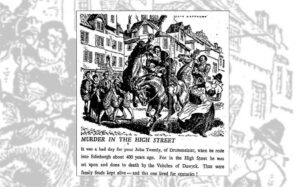
Merlin retraced his steps on the track which in those days ran along the north bank of the river Tweed and crossed over at a ford at Drumelzier. The Christian version is that he was confronted by an angry mob of local herdsmen who, having heard he had been converted, accused him of betraying their faith and the old Gods. It turned violent. The easy way of fording the river without getting your feet wet was on stilts. It was common practice until quite recent times.
Is this perhaps why Merlin was disadvantaged in mid-stream? He was stoned. Half dazed, he toppled into the river and was impaled on a stake for fishermen’s nets. He slipped below the water and was simultaneously drowned. Thus he fulfilled his own prophesy of a triple death by bludgeoning, piercing and drowning, which he had confided to Meldred.
The more logical conclusion is that it was a planned assassination, most likely orchestrated by the two lovers at Dun Meldred whose safety depended on his silence.
He was buried at the place he had requested. There is no visual indication of a grave today but in 1824 the historian William Chalmers was shown the traditional site by the local Minister and he described it as ‘a sort of tumulus”.
Drumelzier and the Merlin Connection
According to legend, Merlin was reputedly buried on the haugh on the east bank of the Tweed, north-west of Drumelzier Church. This legend appears to be at least as old as the Middle Ages, given its inclusion in the Vita Merlini Silvestris (Life of Merlin of the Forest) probably written in the twelfth century (though only a fifteenth century copy survives). The story was included by Walter Bower, the abbot of the abbey of Inchcolm, in his Scotichronicon which was written in the 1440s.
While the location is marked on maps from 1775 onwards, no actual remains have ever been recorded here. In the eighteenth and early nineteenth centuries several historians record having seen the site in the supposed grave and recorded the coordinates of its location. William Chambers described it as “a kind of tumulus”.
It has been speculated that the tradition of this site at Drumelzier may have originated from the discovery of a Bronze Age cist grave.
Which begs the question: are there archaeological roots to this tradition?
A magnetometer geophysics survey of an area around this spot in November 2022 may confirm if there is any archaeological evidence for a cist grave at this location. Geophysics is a non-intrusive survey technique that can identify potential archaeological features buried beneath the surface.
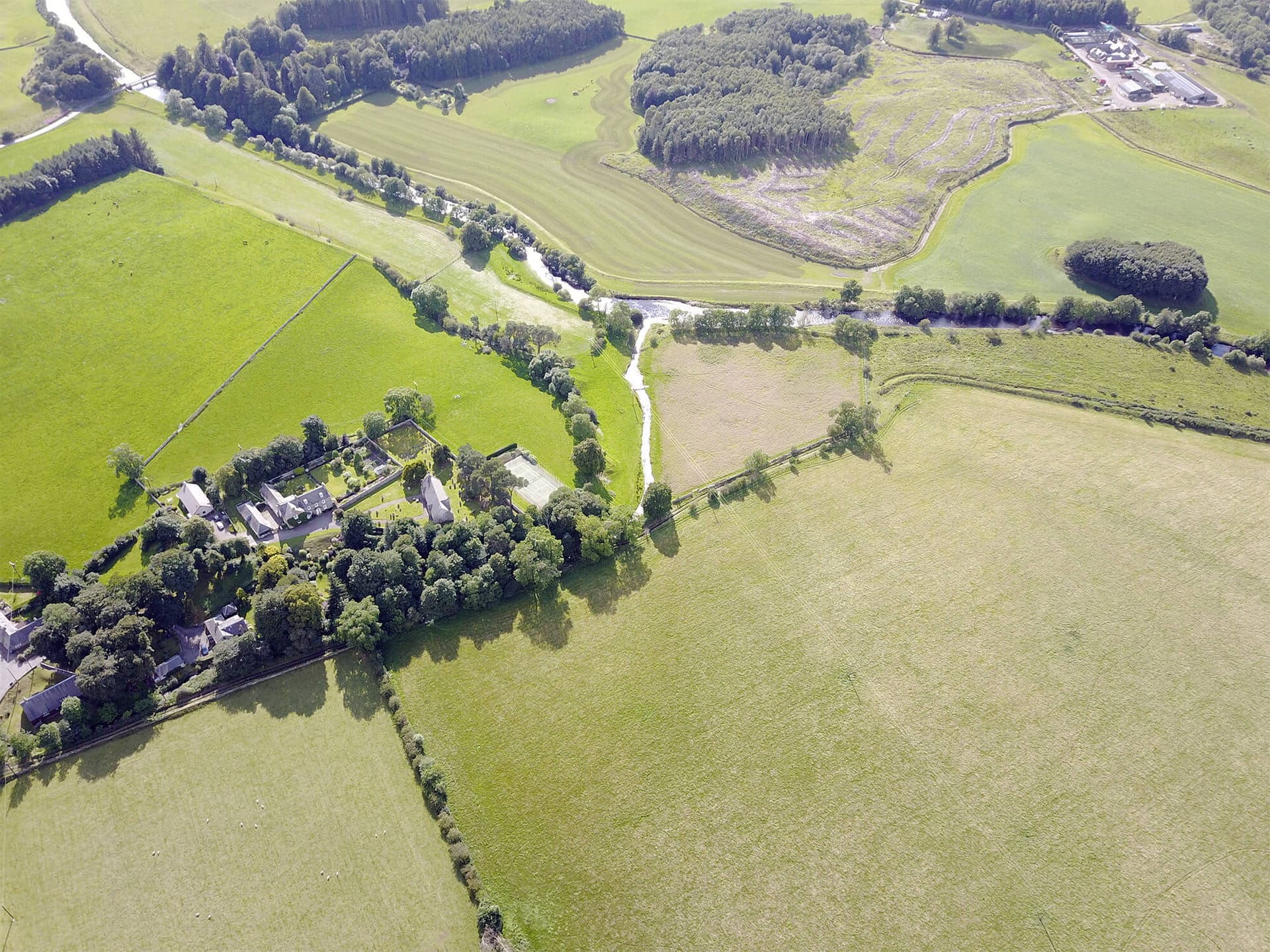
The aim is to gather archaeological evidence for any archaeological features at or close to the site of “Merlin’s grave” and if this evidence provides an archaeological context to the roots of Drumelzier’s association with the Merlin legend.
Robin Crichton.



One Response
Red Book of Hergest. Nothing to do with Hengest.